
By Tracy Campbell
Sometimes an experience continues to shape you long after you have returned home.
When I travelled to South Africa in 2024 as part of the University of Leeds Gryphons Abroad project, I expected to learn about another culture, develop new skills and hopefully make a positive contribution. What I didn’t expect was just how much the experience would change the way I thought about education, community, belonging and what it really means to be successful.
Recently, that journey came full circle in a rather special way.
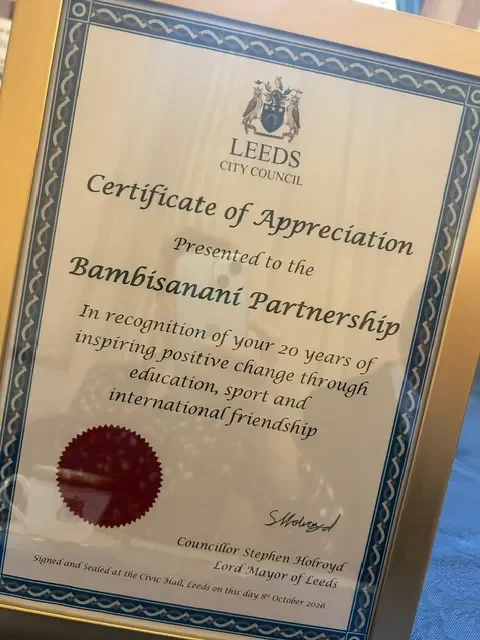
I was invited by Suzzi Garnett, Sports Workforce Manager at the University of Leeds and Gryphons Abroad Project Coordinator, to attend an event with the Lord Mayor of Leeds. The occasion was to recognise 20 years of the Bambisanani Partnership and to present David Geldart, its founder, with a 20-year recognition certificate for inspiring positive change through education, sport and international friendship.
Lord Mayor of Leeds Stephen Holroyd, Tracy Campbell and David Geldhart
The Gryphons Abroad project that I had been fortunate enough to be part of went on to win the Leeds Global Impact Award in 2025. I was also incredibly proud to receive recognition for my own contribution to the project through the Yorkshire Universities Sport Awards.
But as I sat listening to David speak, I found myself reflecting on something much deeper than awards or achievements.
I kept coming back to one word.
Ubuntu.
Ubuntu is an ancient Southern African philosophy, often translated as “humanity” and commonly expressed through the phrase:
“I am because we are.”
David connected this idea to the Zulu proverb Umuntu ngumuntu ngabantu — a person is a person through other people. It speaks to our interconnectedness and the idea that our humanity is shaped through our relationships with others.
I found myself reflecting on why this philosophy, and the work of the Bambisanani Partnership, resonated so deeply with my own journey.
Bambisanani is a Zulu word meaning “hand in hand” or “working together”. Its ethos is rooted in equal partnership and mutual learning between communities in the UK and South Africa. It challenges the assumption that meaningful international volunteering is simply about one community giving and another receiving.
My experience in KwaZulu-Natal reinforced a different understanding: we each bring our own experiences, knowledge and perspectives, and there is value in creating opportunities to share them.
That realisation connects with a much wider change in how I have come to understand my own life.
From individualism to interdependence
I grew up in the 1970s and 1980s, during the Thatcher years, when individualism, self-reliance and personal responsibility became increasingly prominent in British political and social life. Within a wider capitalist culture, success could be understood through individual achievement: working hard, becoming financially independent, owning a home and continually moving upwards and forwards.
I absorbed some of those values.
As a young single mum, I worked hard to build a successful business and become a homeowner. I was proud of what I achieved. Being able to provide for my family, solve problems and stand on my own two feet gave me a sense of security. I had, in effect, learned to pull myself up by my bootstraps.
There is real value in hard work, determination and personal responsibility. But over time, I began to question whether independence alone could fully define success.
Ubuntu offered me another way of thinking about value. It places relationships, reciprocity, community and our responsibilities to one another at the centre. It invites us to consider not only what we can achieve individually, but also how our lives and opportunities are shaped by the people around us.
I have come to understand that accepting support does not diminish independence, just as asking for help is not a sign of weakness. We can be resilient and capable while still recognising that none of us exists in isolation.
In some ways, returning to education has been part of that shift. It has challenged assumptions I had absorbed about success and security, while introducing me to different ways of understanding people’s lives and experiences.
Education changed the language I used to understand my life
Words I had once associated with myself — shame, embarrassment and feeling different — gradually gave way to concepts such as inequality, poverty, discrimination, disadvantage and social barriers.
That was an important change. Education helped me understand how my sense of identity and self-worth had been shaped by my experiences, as well as by the wider social structures and circumstances surrounding them. It gave me the language to make sense of feelings I had struggled to articulate, and the confidence to question the assumptions I had come to hold about myself and the world around me.
I became the first person in my family, across previous generations, to attend university. For me, this was more than a personal milestone; it felt like breaking a cycle that had existed within my family for generations.
My Professional Studies degree opened doors to experiences I could never have imagined when I first walked into the University of Leeds Lifelong Learning Centre. One of those doors led to South Africa.
Following my BA, I went on to complete an MA in Religion, continuing to explore questions of community, belonging, social justice and how we live alongside people whose experiences may be very different from our own.
Education has developed my skills and broadened my career options, but its impact has extended beyond these practical benefits. It has introduced me to new ideas, people and experiences that have helped me understand both myself and the world differently.
The Lifelong Learning Centre played an important part in that journey. It helped me recognise that university was possible for someone like me, and gave me a sense of belonging that I had not previously associated with education.
Learning from one another
My time in South Africa brought many of these ideas to life.
During the project, I worked alongside children, teachers, cycle coaches, school leaders and fellow students. We shared experiences through sport, conversations, moments of laughter and the everyday challenges of working in unfamiliar surroundings.
The relationships I developed were perhaps the most lasting part of the experience. Spending time with people from different backgrounds, cultures, generations and life experiences showed me the value of creating spaces where we can share perspectives and knowledge. Our differences did not need to be overcome; they became part of what made the experience enriching.
This mutual learning took different forms. At Gratton School Leadership Week, I had to adapt my communication, activities and approach to meet the needs of different children. Building trust, encouraging participation and finding ways to engage young people reminded me that effective leadership is not simply about giving instructions. It also requires patience, flexibility and an understanding of the people you are working with.
The cycle clinics in KwaZulu-Natal offered another perspective. Supporting girls to learn to ride bicycles, while talking about culture, equality and women’s opportunities, brought together sport, confidence and social change. These moments were not simply about developing a skill. They created opportunities to share experiences and consider how our different circumstances shape what we see as possible.
I was also learning alongside younger university students. Living with fellow students during the month-long trip was a unique part of the experience that I would probably not have had otherwise, particularly while still having children at home. We brought different perspectives and life experiences to the group, and the opportunity to share the adventure across generations became one of its unexpected pleasures.
Looking back, I can see how these experiences reflected the Bambisanani ethos. Partnership was not an abstract idea; it was something practised through working alongside one another, adapting to different situations and recognising that everyone had something to contribute.
A journey that continues
When I think back to the person who first opened that Gryphons Abroad email, I remember the uncertainty.
I was anxious about leaving my family. I wondered whether I would fit in with younger students, whether I was physically capable of taking part and how I would manage in an unfamiliar culture.
But I went.
And I discovered that my age was not a barrier, nor was my life experience something to hide. The responsibilities and challenges that had shaped my life were also part of what I could bring to the experience.
Returning to university, completing my degrees and volunteering abroad have all expanded my sense of what is possible. Yet perhaps the most important change has been in how I understand the relationship between individual achievement and the communities that make our opportunities possible.
We rightly celebrate resilience: the person who works hard, overcomes obstacles and builds something from very little. But Ubuntu reminds us that our achievements rarely happen entirely alone. Encouragement, opportunity, relationships and shared knowledge all play their part.
As I stood at the event in Leeds, marking 20 years of a partnership connecting people through education, sport and international friendship, I felt grateful.
Grateful to those who encouraged me to apply for Gryphons Abroad. Grateful to the University of Leeds Lifelong Learning Centre for helping me see a place for myself at university. Grateful to the students who shared the adventure, and to the children, teachers and colleagues in South Africa who welcomed us into their communities.
And grateful to the Bambisanani Partnership for demonstrating what can grow when people work together as partners, sharing knowledge and creating opportunities for mutual learning.
Suzzi Garnett, Gryphons Abroad project coordinator
My journey from a young single mum who missed out on university to a mature student, graduate, international volunteer and postgraduate has taken me places I could never have predicted.
It has not been simply a journey towards greater independence. It has also been a journey towards connection: finding my place, discovering new possibilities and recognising the value of what we can learn and create together.
“I am because we are.”
Those words now carry a deeper meaning for me.
The journey continues — not because I have reached a final destination, but because there is always more to learn, more people to meet and more opportunities to build something together.
